June 18, 2025
WEB REPORT
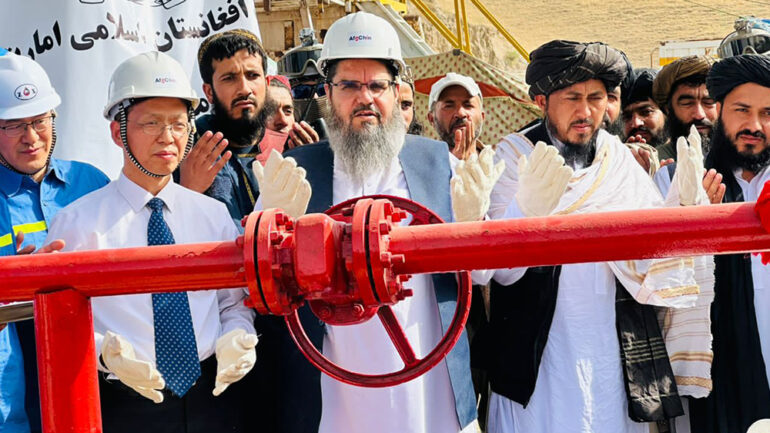
In early 2023, Afghanistan’s Taliban-led government signed what was hailed as a groundbreaking oil extraction agreement with the Xinjiang Central Asia Petroleum and Gas Company (CAPEIC), a subsidiary of China’s state-run CNPC.
Background: A Deal of Strategic Importance
The 25-year contract granted CAPEIC rights to explore and extract petroleum from the resource-rich Amu Darya basin in northern Afghanistan, a region long believed to house vast untapped energy reserves.
At the time, the deal was seen as a lifeline for Afghanistan’s struggling economy and a symbolic moment of international engagement under Taliban rule. The terms were ambitious. CAPEIC pledged an initial investment of $150 million within the first year, increasing to $540 million over the subsequent three years. Oil production was projected to grow from 200 tonnes per day to 1,000 tonnes, with Afghanistan initially receiving a 20% equity share, later increasing to 75%.
The agreement also included commitments to infrastructure development and job creation, with thousands of Afghan workers expected to be employed in the oil fields.
A 15% royalty on extracted oil was to bolster national revenues. Taliban officials lauded the project as “the largest foreign investment since their return to power,” projecting it as a cornerstone of the regime’s bid for economic legitimacy on the global stage.
But just over two years later, the ambitious project has unraveled.
At the time, it was celebrated by Taliban officials as “the largest foreign investment project since their return to power,” and viewed as a breakthrough in the group’s quest for economic legitimacy.
Why the Deal Fell Apart
More than two years later, the Taliban’s Ministry of Mines and Petroleum has officially revoked the contract, citing a series of contractual violations and underperformance by CAPEIC.
- Failure to Fulfill Investment Commitments
CAPEIC allegedly failed to disburse the agreed-upon investments in full and on time, particularly in the initial stages, which stalled the project’s momentum.
- Unpaid Royalties and Revenue Losses
The Afghan government reported over $68 million in unpaid dues, with CAPEIC allegedly avoiding or delaying royalty payments on early extraction.
- Incomplete Geological and Seismic Surveys
The company failed to complete critical survey work required to begin large-scale drilling. Without solid data, the project could not move beyond the early pilot stages.
- Environmental and Operational Irregularities
Officials noted a disregard for environmental regulations, particularly concerning water usage and waste disposal, raising red flags about the firm’s long-term commitment to sustainable practices.
- Broken Promises on Infrastructure and Jobs
Despite initial commitments to build roads, power grids, and water systems, CAPEIC reportedly delivered little to no development, contributing to local frustration. Promised employment for Afghan engineers and workers never materialized at scale.
- Lack of Transparency and Poor Communication
The Ministry described CAPEIC’s operational conduct as opaque, with inconsistent reporting and a lack of collaboration with local authorities and regulators.
Official Justification: ‘Violation of Sovereign Interests’
In a statement, Afghan officials emphasized that the decision to cancel the deal was not political, but based on “contractual non-compliance” and a failure to uphold obligations that protected Afghanistan’s economic sovereignty.
“If any company—whether Chinese or otherwise—violates our national interest or neglects its commitments, we will not allow it to exploit our resources,” said an official of the Ministry of Mines.
The official also clarified that CAPEIC is not directly equivalent to the Chinese state, emphasizing the Afghan government’s stance that this cancellation should not affect diplomatic relations with Beijing.
China’s Response: Silence So Far
As of now, Chinese authorities have not issued an official reaction. The CAPEIC website and affiliated Chinese media outlets have remained silent on the matter. The incident comes at a sensitive time, as Beijing continues to explore mineral investments in Afghanistan under the framework of the Belt and Road Initiative (BRI).
Economic and Geopolitical Implications
The Amu Darya region is believed to hold at least 87 million barrels of oil reserves, enough to satisfy Afghanistan’s domestic demand for nearly a decade. Wider estimates suggest over 1.8 billion barrels of petroleum and untapped gas reserves lie beneath Afghan soil.
The cancellation of the deal:
Sets a precedent for future contracts by emphasizing transparency and accountability
May deter foreign firms unwilling to meet stringent terms
It could affect China’s broader investment appetite in Afghanistan
Signals a shift in Taliban economic policy, from dependency to selectivity
Conclusion: A Test Case for Taliban’s Economic Strategy
The cancellation of the CAPEIC deal marks a significant moment in Afghanistan’s post-war economic evolution. The Taliban-led government, often criticized for a lack of engagement with global standards, has now set a clear message: economic agreements will be honored only when obligations are met.
This move may hurt short-term investor confidence, but it could also boost credibility among responsible partners seeking transparency and long-term collaboration. If managed wisely, the Taliban’s rejection of underperformance may prove to be a defining step toward economic sovereignty and resource nationalism.
st