The Saudi-UAE split in Yemen highlights how proxy warfare is reshaping power, alliances, and instability across the Middle East and the Red Sea corridor.
BY: Mohammad Eslami / TRT WORLD
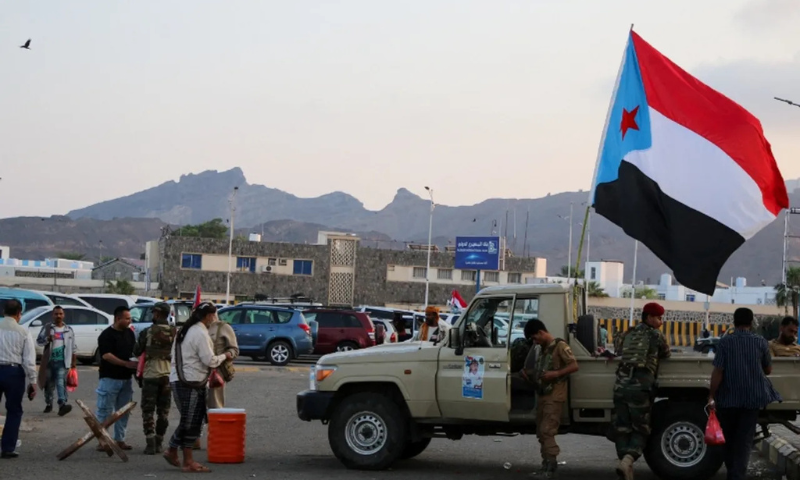
Over the past week, Saudi fighter jets carried out multiple air strikes in Yemen’s Hadramaut province, targeting positions linked to the Southern Transitional Council, a UAE-backed separatist force. Saudi Arabia has also publicly accused the United Arab Emirates, a former ally in the Yemen civil war, of actions that threaten its national security.
These strikes and accusations go beyond a simple battlefield episode. They reveal a public rift in what was once portrayed as a united Gulf intervention in Yemen and hint at a wider regional strategy that is beginning to unravel. The UAE has increasingly relied on proxy militias, local armed partners, and parallel security structures to project power beyond its borders. This approach has produced short-term tactical gains, expanding Emirati influence along strategic coastlines, ports, and trade corridors.
Yet it is also accelerating a more dangerous trend: the normalisation of state-backed fragmentation in some of the Middle East’s most fragile countries. What is unfolding now is not merely a dispute between allies. It is a contest over how power is exercised in a region already hollowed out by war.
The UAE’s growing use of proxy forces represents a significant shift in the regional balance of power. Unlike traditional interventions that support central governments, Abu Dhabi has invested in cultivating armed actors that operate alongside, or openly against, state institutions. In Yemen, Emirati support for the Southern Transitional Council has effectively created a rival authority to the internationally recognised government backed by Saudi Arabia. Across the Red Sea basin, this model prioritises control over territory, ports, and security nodes rather than the reconstruction of sovereign governance.
The danger is not confined to instability in individual countries. It is the precedent being set. When regional powers openly sponsor militias to secure influence, fragmentation becomes policy rather than pathology. States no longer serve as the fundamental units of order; armed networks and local strongmen increasingly dictate power. Over time, this trend is reshaping Middle East politics into a landscape where borders matter less than loyalties and where external actors manage instability rather than resolve it.
Expanding the Competition Theatre
Nowhere is this shift more visible than in Yemen. The Saudi-led coalition was originally formed with a clear strategic purpose: to counter the Houthis and, by extension, limit Iran’s influence along the Red Sea and the Bab el-Mandeb strait, one of the world’s most critical maritime chokepoints. Yemen is not only a domestic conflict but also a frontline in a broader regional balance-of-power struggle.
For several years, Saudi Arabia and the UAE appeared aligned around that objective. But over time, particularly in the past year, the focus of the conflict has subtly but decisively shifted. As US and Israeli military pressure on the Houthis intensified and Iran faced direct and indirect blows across the region, the immediate threat perception that once united the coalition began to recede.
A new fault line emerged within the coalition itself. The recent Saudi air strikes in Hadramaut underscore how far this divergence has gone. Riyadh now views the growing military and political dominance of the Southern Transitional Council in eastern and southern Yemen as a direct challenge to its security interests and to the principle of a unified Yemeni state. Abu Dhabi, by contrast, appears increasingly willing to tolerate—or even facilitate—a fragmented Yemen if it secures dependable partners along the coast and sustained influence over key ports and maritime routes.
What began as a coordinated campaign against the Houthis has evolved into a far more complex contest. Yemen has become not only a site of prolonged civil war but also an arena of intra-Gulf rivalry, where former allies now pursue diverging endgames. The result has been diplomatic paralysis and growing volatility on the ground, even as millions of Yemenis remain trapped in one of the world’s gravest humanitarian catastrophes.
Saudi Arabia sees stability along the Red Sea as a core national interest. Egypt is sensitive to any developments affecting Nile security and regional military balances. Iran has shown increasing interest in exploiting power vacuums along maritime routes. In this crowded strategic environment, the UAE’s assertive posture risks intensifying rivalries rather than managing them. What begins as competition for influence can quickly slide into proxy escalation, particularly in states where institutions have already collapsed.
Short-Term Gains, Long-Term Costs
There is no denying that the UAE’s approach has delivered results. Proxy forces are cheaper than direct military deployments, politically deniable, and often more adaptable to local conditions. They can secure ports, suppress adversaries, and shape political outcomes without the burdens of occupation.
But these gains come at a cost. Militias, once empowered, rarely remain obedient. Their interests evolve, ambitions grow, and accountability fades. History across the region, from Lebanon to Libya, offers ample warning of what happens when armed groups outgrow their patrons.
If the forces the UAE backs in Yemen become uncontrollable, the blowback will not remain local. It will reverberate through trade routes, energy markets, and regional security structures. Fragmented states do not absorb instability—they export it.
The Saudi air strikes in Hadramaut may mark a turning point. They suggest that Riyadh is no longer willing to quietly accommodate Abu Dhabi’s proxy strategy when it clashes with Saudi core interests.
More broadly, these developments raise uncomfortable questions for the region’s power brokers. Is the Middle East moving toward a future where influence is exercised through militias rather than institutions? Can fragile states survive when external actors prioritise leverage over legitimacy? How many overlapping proxy wars can the region absorb before local conflicts fuse into something far larger?
The UAE is not alone in this game, but it has become one of its most skilled practitioners, making its choices especially consequential. Short-term security gains achieved through fragmentation may seem seductive, yet in a region already scarred by state collapse, the long-term consequences could be devastating. Yemen is not an isolated case.
These events are warning signs of what happens when power is pursued without a viable endgame. The question now is whether regional leaders recognize that danger—or continue down a path where today’s proxies become tomorrow’s uncontrollable fires.
SOURCE: TRT WORLD