
WEB REPORT
ISLAMABAD: June 20, 2025
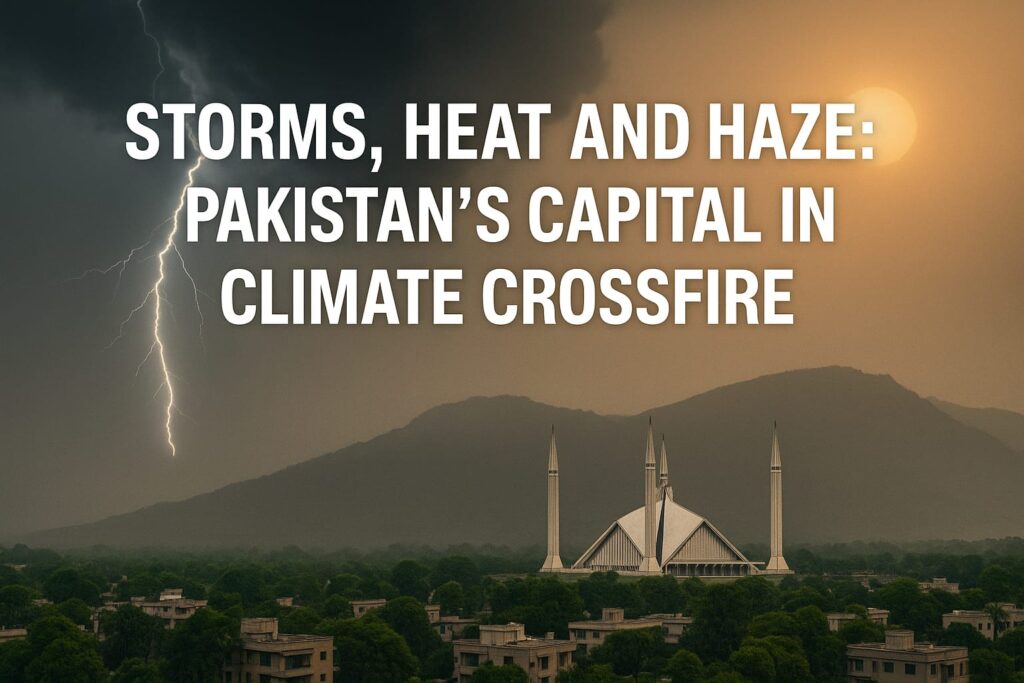
On an otherwise quiet spring afternoon in April, skies over Pakistan’s capital darkened ominously. What began as a breeze quickly escalated into Chaos. Within minutes, hailstones the size of golf balls rained down across Islamabad, smashing windscreens, punching holes in rooftops, and stripping the trees bare.
Residents recall the sound of glass shattering and metal crumpling, more a war zone than a weather event. Cars stood dented, solar panels shattered, streets littered with broken branches and debris. It was a chilling reminder: Pakistan’s changing climate is no longer a looming threat, it has arrived.
And it didn’t stop there. Just two months after that hailstorm, Islamabad is now baking under an unrelenting wave of extreme heat. Temperatures have surged past 45°C, with little relief even after sunset. Health officials have warned of increasing cases of heat stroke and dehydration, particularly among vulnerable groups like children and the elderly.
Power outages across several neighborhoods have compounded the crisis. With fans and air conditioners falling silent, nights have become as punishing as days., “We’ve barely slept this past week,” says Amina Khalid, a school teacher in suburban BaraKahu neighborhood.
“No electricity, no cool air. The walls themselves feel like they’re burning.”
Meteorologists are calling it a climate whiplash, sudden switches from violent storms and hail to drought-like heat. The once-predictable rhythm of Pakistan’s seasons has been disrupted, replaced with a string of meteorological extremes that now seem to defy logic.
“This is not an anomaly,” says Riaz Khan, a senior meteorologist and former chief of the Pakistan Meteorological Department. “These events are linked. The atmosphere is behaving like a pressure cooker, surging with instability due to rising global temperatures.”
An Urban Powder Keg:
But it’s not just the skies that are turning against Islamabad. Decades of unregulated urban sprawl have turned the capital into a tinderbox of environmental vulnerability.
A study published in the Sustainability (MDPI) reveals that over 3,300 acres of agricultural land in Islamabad were converted into built-up areas between 1992 and 2005, most of it without environmental assessments or long-term planning. Another analysis on Research Gate notes a 41.7% expansion in the city’s built-up area between 1979 and 2019.
During the same period, forest cover dropped by over 9%, and water bodies shrank by more than 1%.The result: weakened green buffers, urban heat islands, flash flooding, and biodiversity loss.
An even more alarming report on the impact of cooperative housing societies shows that up to 40% of Islamabad’s cultivable land has now been swallowed by gated communities and housing schemes. “We are building ourselves into a disaster,” the report warns.
Mountains have been leveled, hills shaved bare, and trees felled in the thousands, all in the name of development. In many places, the city now stands as a skeleton of concrete, stripped of the natural defenses that once moderated its climate.
The Unseen Costs:
Pakistan’s climate crisis cannot be separated from its environmental mismanagement. Pollution, both imported and homegrown, has intensified the damage. For decades of cross-border fallout due to conflict in Afghanistan to the unchecked release of industrial waste into rivers, the country’s ecosystems are under siege.
In Punjab, particularly in Lahore, winter brings toxic smog driven by stubble burning and vehicular emissions. Open garbage fires, rampant plastic use despite bans, and the near-absence of recycling systems make things worse.
PM2.5 levels, airborne particles small enough to penetrate deep into the lungs, have reached alarming levels. The health costs of this pollution are becoming clear: rising cases of asthma, heart disease, and respiratory cancers, especially in urban centers.
Planning Paralysis:
Pakistan has policies in place. Master plans, zoning codes, climate strategies, they exist, but enforcement remains weak.
Decades of political interference, underfunded institutions, and outdated regulations have eroded the state’s ability to govern urban growth.
A rising culture of speculative real estate investment—where owning land is seen as the only form of financial security, has led to a boom in private housing schemes, even at the cost of food security and ecological stability.
As cities like Islamabad expand outward into forests and farmlands, their vulnerability to climate shocks only deepens. And the lack of coordination between federal, provincial, and local authorities leaves no one clearly accountable.
A Narrow Window for Change:
There are glimmers of hope. Federal Minister for Climate Change and Environmental Coordination, Senator Musadik Malik, has advocated for a “Green Skills Revolution,” pushing for sustainable economic models, investment in climate technology, and education.
Policy frameworks such as the National Adaptation Plan and the Long-Term Low-Emissions Strategy point in the right direction, but without implementation, they risk becoming just more documents in dusty drawers.
What is urgently needed is not more rhetoric, but political will, community engagement, and a complete reimagining of how Pakistan’s cities grow.
Islamabad’s recent hailstorm and heatwave were not isolated events. They are warnings from a planet out of balance. How many more will it take before we act?
st