Pezeshkian seeks $10bn trade goal, strategic cooperation. Islamabad reaffirms solidarity after US-Israel attacks on Iran as experts warn of “Indo-Israel axis” and regional destabilisation efforts
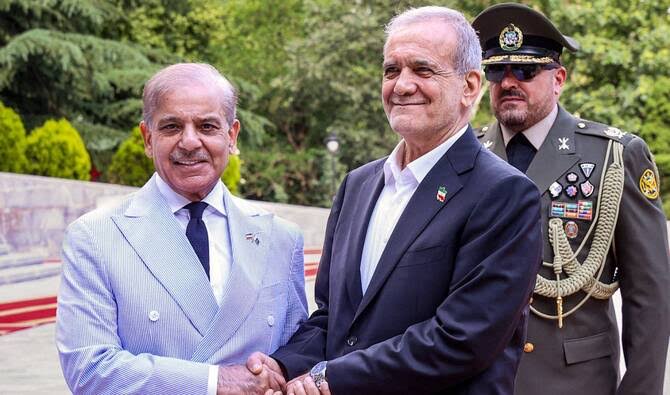
Iranian President Masoud Pezeshkian began a two-day state visit to Pakistan on Saturday, seeking to strengthen economic and security cooperation with Islamabad amid soaring tensions in the Middle East following Israeli and United States airstrikes on Iranian soil.
The trip, Pezeshkian’s first since assuming office, underscores a strategic pivot by Tehran to deepen ties with regional neighbours as it reels from the most intense wave of attacks in recent years. These strikes targeted nuclear and military infrastructure and left over 1,000 people dead, according to Iranian officials.
Warm Reception in Lahore
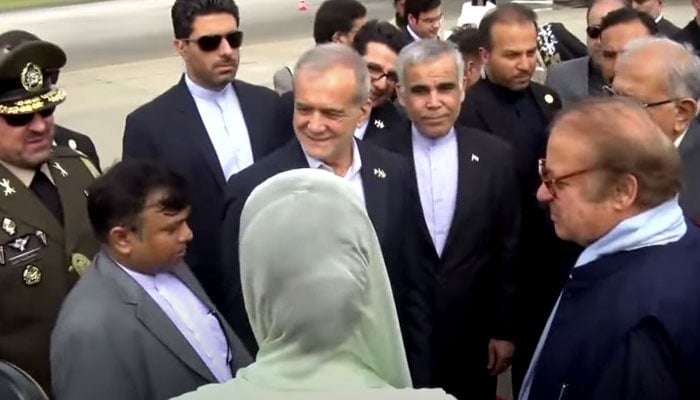
Touching down in Lahore, Pezeshkian was welcomed by former Prime Minister Nawaz Sharif and Punjab Chief Minister Maryam Nawaz. His visit began with a symbolic stop at the mausoleum of the national poet, Allama Iqbal, before continuing to Islamabad for high-level talks with President Asif Ali Zardari and Prime Minister Shehbaz Sharif.
Iranian Foreign Minister Abbas Araghchi and other senior officials are accompanying Pezeshkian, signalling the importance Tehran places on the visit.
Trade Push and Regional Vision
Ahead of his departure, Pezeshkian told Iranian media the visit aims to push bilateral trade to $10 billion annually, up from the current $3 billion. He said both countries must prioritise expanding trade via land, air, and sea routes, an initiative he described as key to integrating with China’s Belt and Road Initiative and establishing a corridor through Iran to Europe.
“Through Pakistan, Iran can connect to the Silk Road,” he said. “This strategic corridor is vital for both countries’ futures.”
Tehran and Islamabad had previously agreed in 2024 to enhance trade over five years, but progress has been slow due to international sanctions and banking constraints.
Solidarity in a Shifting Geopolitical Landscape
Pakistan’s Foreign Office described the visit as a “reflection of deep solidarity” with Iran. Foreign Minister Ishaq Dar had strongly condemned the US-Israeli strikes during a recent Shanghai Cooperation Organisation (SCO) meeting in Tianjin, calling them “unacceptable” and warning of further destabilisation in the region.
Pezeshkian, for his part, praised Pakistan for “firmly supporting Iran’s territorial integrity” and standing against what he described as aggression aimed at weakening Muslim unity.
A New Axis of Resistance?
At a policy roundtable hosted by the Islamabad Policy Institute (IPI), experts and lawmakers warned of an emerging “Indo-Israel axis” aimed at countering Iran and Pakistan.
Senator Mushahid Hussain, chair of the Senate Foreign Affairs Committee, alleged that Israel supported India during its skirmishes with Pakistan, and now India was offering “strategic cover” for Israeli actions against Iran. He cited the use of Israeli Harop drones operated from Indian territory as a troubling precedent.
IPI Chair Dr Shireen Mazari pointed to unresolved challenges that continue to hamper bilateral ties, particularly border security, foreign interference, and the long-delayed Iran-Pakistan gas pipeline project.
Strategic Realignment in the Making?
As Iranian President Masoud Pezeshkian begins his first official visit to Pakistan, analysts say the renewed momentum in Tehran-Islamabad ties may mark the early signs of a broader strategic realignment. With Western influence receding and tensions with Israel and the United States intensifying, both nations appear eager to strengthen regional cooperation rooted in shared interests.
With overlapping goals in trade, energy, and security, and a growing emphasis on resisting external interference, Iran and Pakistan seem poised to move beyond symbolic gestures and toward a more deliberate, coordinated partnership.
ST