As Bangladesh heads toward pivotal elections, a student-led uprising, shifting alliances, and youth-driven politics are redefining power at home and recalibrating regional dynamics.
By: Masood Aijazi
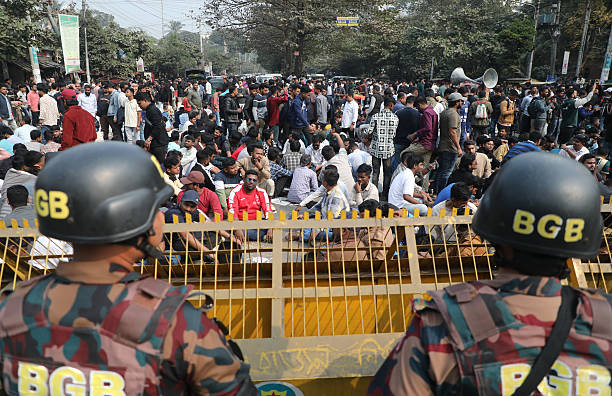
Bangladesh, which for the past year and a half has remained at the centre of international attention due to a student-led uprising and Sheikh Hasina’s taking refuge in India, is now approaching elections of exceptional political significance. With only days remaining before the polls scheduled for February 12, the intensity of electoral activity has reached its peak, and the eyes of the world are firmly fixed on the country.
The protest movement that began in 2024 — driven by extraordinary sacrifices made by students — is now entering its next and decisive phase. What began as resistance has evolved into an effort to reshape the political order through the ballot. The interim government, formed under the leadership of Nobel laureate Dr. Muhammad Yunus, has initiated preparations to hold elections in accordance with its stated commitments. Yet uncertainty persists. There remains no absolute assurance that the elections will ultimately be allowed to proceed. Even if they do, a fundamental question remains unresolved: will they be transparent and fair?
India, which has invested heavily — politically, economically, and strategically — in Bangladesh over many years, now confronts an uncomfortable reality. Will New Delhi be willing to accept electoral outcomes that do not align with its long-standing preferences? There is cautious hope that in the coming weeks, a new political dawn may emerge from the eastern horizon.
With a population of approximately 175 million, Bangladesh is the world’s eighth-largest country by population. The 13th national parliamentary elections will be held on February 12, 2026, alongside a referendum on constitutional reforms. These reforms include the proposed establishment of an upper house of parliament, to be elected through proportional representation.
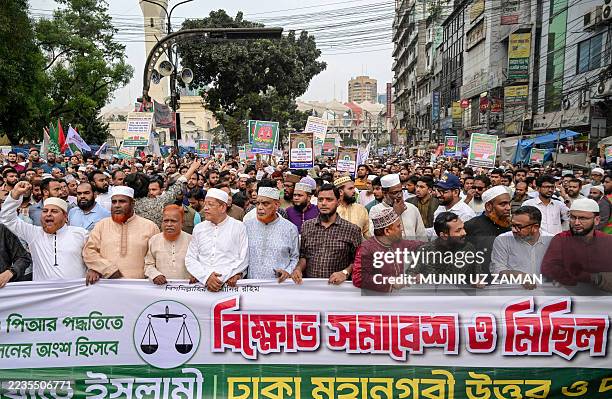
Across the country, a total of 2,568 nomination papers have already been filed, while January 20 has been set as the final date for withdrawals. One of the most complex challenges facing the Election Commission is the issue of dual nationality, which remains widespread among influential political figures. Expected prime ministerial candidates Tareq Rahman and Dr. Shafiqur Rahman have both held recent meetings with Dr. Muhammad Yunus. Meanwhile, leaders of the Bangladesh Nationalist Party (BNP) and Jamaat-e-Islami have begun extensive nationwide tours, including helicopter campaigns.
Authorities have designated 6,748 polling stations as “highly sensitive” and finalized plans for large-scale deployment of police and security personnel.
The contest for the 300 parliamentary seats is expected to be fiercely competitive. The principal battle is between the BNP-led alliance (symbol: sheaf of rice) and the broad electoral coalition formed under the leadership of Jamaat-e-Islami (symbol: scales). The Awami League, which governed uninterruptedly for 15 years under Sheikh Hasina, remains barred from participation.
International election observers have already begun arriving in Dhaka. The European Union has deployed 56 observers across Bangladesh’s 64 districts to monitor the electoral process and produce detailed assessments. Representatives from the U.S.-based International Republican Institute and the National Democratic Institute are also expected to observe the elections.
On December 25, 2025, after 17 years in exile, 60-year-old Tareq Rahman returned to Bangladesh and assumed the chairmanship of the Bangladesh Nationalist Party following the death of his mother. Indian and Western media outlets have projected him as Bangladesh’s likely next prime minister. Public opinion surveys, however, suggest a far more competitive and uncertain political landscape.
According to a survey released on January 12, 2026, by the International Institute for Law and Development and its partners, the difference in popularity between Jamaat-e-Islami and the BNP has narrowed to just 1.1 percentage points. Conducted between November 21 and December 20, 2025, the survey places BNP support at 34.7 percent and Jamaat-e-Islami at 33.6 percent. The National Citizens Party (NCP) stands at 7.1 percent, Islamic Andolan at 3.1 percent, and other parties collectively at 4.5 percent.
When combined, the Jamaat-e-Islami–NCP alliance reaches 40.7 percent, compared to BNP’s 34.7 percent. Based on scientifically structured sampling across all 64 districts and 295 constituencies, with 22,174 respondents, the survey indicates a six-point lead for the alliance. Nevertheless, Bangladesh’s fragmented constituency dynamics make definitive predictions impossible. What is beyond doubt is that the remaining 17 percent of undecided voters — largely young people — will be decisive.
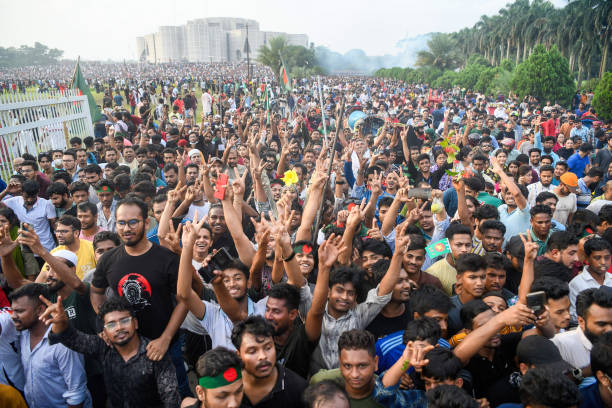
Among students and youth, anti-India sentiment is widespread. While references to Pakistan may exist primarily in textbooks, India’s influence during Sheikh Hasina’s rule was experienced directly and tangibly. These sentiments were further intensified by the killing of Sharif Usman bin Hadi on December 18, 2025. His funeral drew hundreds of thousands, and weeks later, Dhaka’s Shahbagh area continues to resonate daily with chants such as “Delhi or Dhaka? Dhaka! Dhaka!” and “We are all Hadi.”
The political aftershocks of Hadi’s killing are expected to shape electoral outcomes, as a moment of reckoning approaches.
Youth participation has always been important in elections, but in Bangladesh’s current context it is central. These elections are, in essence, the political culmination of student and youth struggle. Nearly 28 percent of Bangladesh’s population falls between the ages of 15 and 29. The median age is 29, 42.6 percent of the population resides in urban areas, and literacy stands at nearly 78 percent.
Recent student-union elections across major universities — including Dhaka University, Jahangirnagar University, Jagannath University, Chattogram, and Rajshahi — have produced historic landslide victories for Islami Chhatra Shibir. Similar dynamics were observed at Shahjalal University of Science and Technology, where elections were initially postponed amid fears of another Shibir victory, only to be reinstated after student protests.
These outcomes provide strong evidence of Jamaat-e-Islami’s growing appeal among youth and Generation Z. The inclusion of the student-led National Citizens Party within the Jamaat-led electoral alliance has further strengthened this momentum. BNP leaders insist that student-union results have no bearing on national elections, but the coming weeks will test that claim.
According to reporting in Dhaka’s daily Amar Desh, India has grown increasingly anxious to re-establish political influence following the collapse of the Awami League. Indian External Affairs Minister S. Jaishankar’s participation in Khaleda Zia’s funeral and his public messages of respect signaled New Delhi’s desire to see the BNP return to power — albeit without Jamaat-e-Islami as an ally. Indian media has actively portrayed Jamaat as “pro-Pakistan” and “anti-India,” seeking to delegitimize it internationally.
This strategy reflects a broader regional approach aimed at morally weakening political forces deemed unfavorable by Delhi. Although the Awami League has announced an election boycott, liberal, secular, and India-aligned circles are widely expected to shift their weight toward the BNP. The BNP has already nominated several former Awami League figures as candidates.
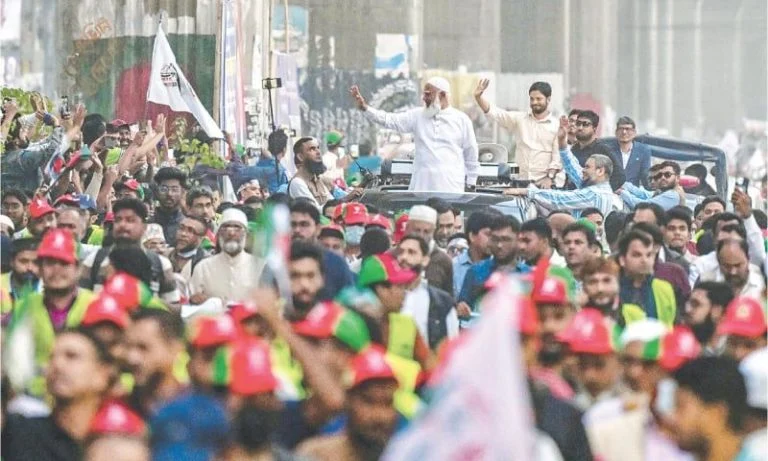
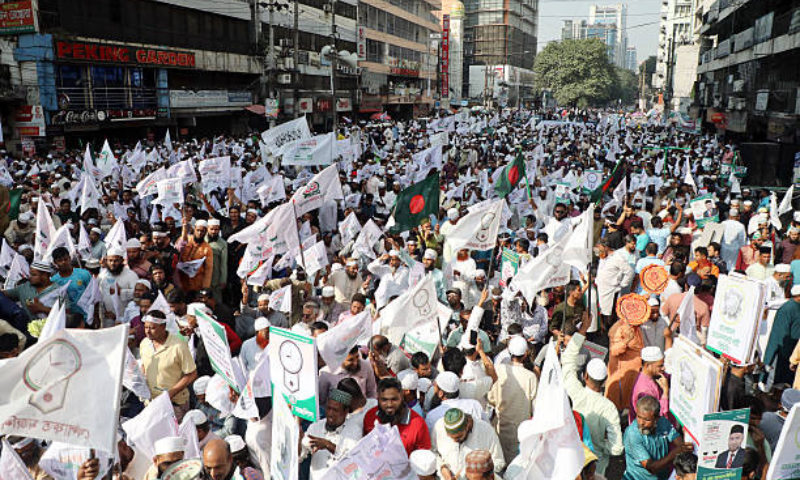
Meanwhile, Jamaat-e-Islami’s rallies and marches are drawing massive public participation across Bangladesh. After fifteen years of political exclusion, the party has seized the opportunity to demonstrate its organizational strength. Notably, Jamaat has emphasized surveys, data, and strategic candidate selection over street mobilization. For the first time, it has issued tickets to respected non-members and even nominated a non-Muslim candidate, Krishna Dhan Das. As a result, members of Hindu and Christian communities are openly supporting the party.
In a January 2 interview, Jamaat’s leadership expressed readiness to participate in a unity government with all political forces, including the BNP. This conciliatory and pragmatic posture has significantly eroded the long-standing perception of Jamaat as an extremist or exclusionary organization.
A major recent development has been Islamic Andolan Bangladesh’s decision to withdraw from the Jamaat-led alliance and contest the elections independently in 268 constituencies. Despite commanding only 3–5 percent of the vote and never having won a parliamentary seat, the party’s decision has surprised observers. Analysts attribute this move to internal clerical rivalries, ideological hostility toward Jamaat’s rise, and strategic calculations related to proportional representation in a future upper house.
Despite these complexities, Jamaat-e-Islami is widely expected to emerge as the largest single political force in the new parliament, followed by the National Citizens Party. Internal assessments suggest Jamaat is targeting 190–200 seats and has identified 170–175 constituencies where victory appears achievable.
Whatever the final results, one conclusion is unavoidable: Jamaat-e-Islami has emerged as a central force in Bangladesh’s newly reconfigured political landscape, particularly among students and youth. Understanding this rise requires recognizing decades of repression, executions, disappearances, and imprisonment endured under Sheikh Hasina’s rule — and even earlier, during and after the 1971 war.
The long and arduous journey of Jamaat-e-Islami in Bangladesh, and the success it has ultimately produced, offers profound lessons for Islamist political movements elsewhere, particularly in Pakistan. The central truth is that for ideological movements, steadfast adherence to their worldview, mission, and purpose — regardless of changing circumstances — remains the true key to success.
Claims that the current strategy can never succeed will, in time, be proven wrong. The essential lesson is to remain firmly rooted in principles while sustaining hope. Through patience, strategic wisdom, continuous religious outreach, and close engagement with society, transformative change can be achieved repeatedly.
Whatever the final outcome of these elections, they are likely to carry the process of dismantling India’s long-standing dominance in Bangladesh toward completion, while opening a new chapter of warmth and cooperation in Pakistan–Bangladesh relations, with far-reaching implications for South Asia.

Masood Aijazi, The Author: Associate Director, Foreign Affairs