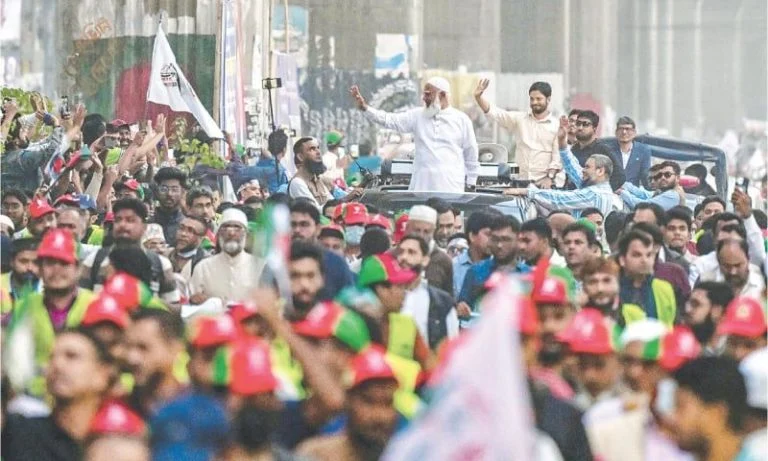
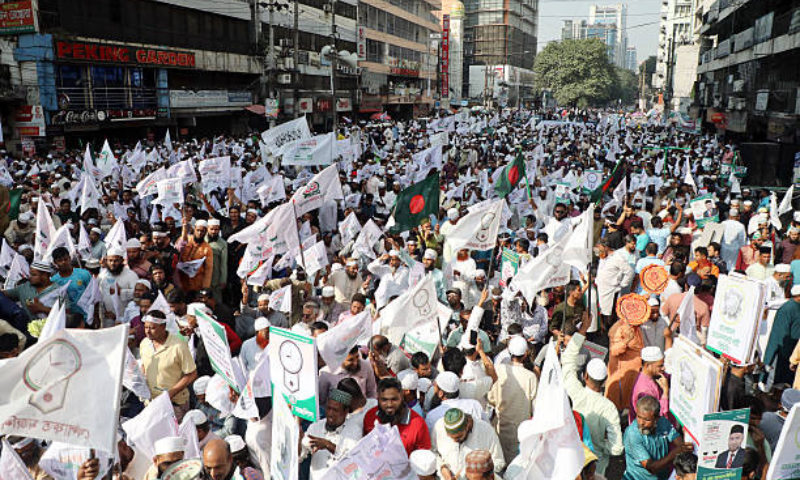
For the first time in its chequered history, the Islamic party has a credible chance of leading a governing alliance.
BY Masum Billah | Courtesy Al Jazeera
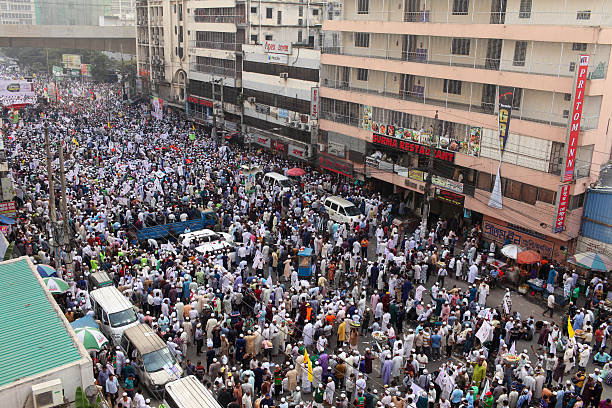
Dhaka, Bangladesh – For the first time in his life, Abdur Razzak, a 45-year-old banker in Bangladesh’s Faridpur district, believes the political party he supports has a real chance of coming to power as the leader of a governing alliance.
Campaigning for the Jamaat-e-Islami party’s “scales” symbol in his town, Razzak said people he was meeting with were “united in voting” for Jamaat, as the Islamist party is commonly referred to in the world’s eighth-most populous country, home to the fourth-largest Muslim population on the planet.
The interim government led by Nobel Peace Prize laureate Muhammad Yunus, which replaced Sheikh Hasina after the uprising, has banned her Awami League party. This has turned the upcoming election into a bipolar contest between the frontrunner, the Bangladesh Nationalist Party (BNP), and an electoral alliance formed by Jamaat-e-Islami with the National Citizen Party (NCP) — a group created by student leaders of the 2024 uprising alongside other Islamic parties.
Razzak’s confidence has been bolstered by recent opinion polls suggesting Jamaat is rapidly closing the gap with the BNP, its longtime senior coalition partner.
A December survey by the United States-based International Republican Institute placed BNP support at 33 percent, with Jamaat close behind at 29 percent. Another poll conducted last week by leading Bangladeshi agencies — including NarratiV, Projection BD, the International Institute of Law and Diplomacy (IILD) and the Jagoron Foundation — showed the BNP at 34.7 percent, narrowly ahead of Jamaat at 33.6 percent.
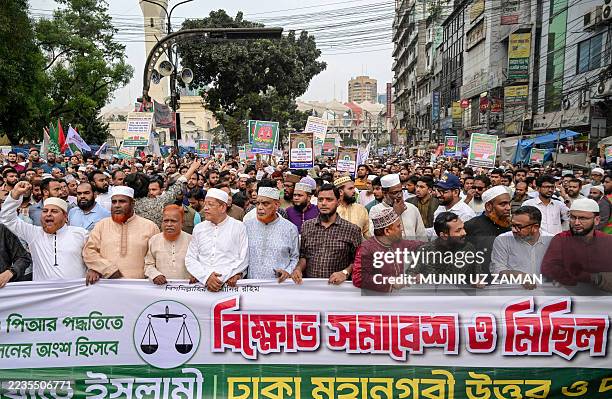
If the Jamaat-led alliance were to secure victory, it would mark a dramatic reversal for a party that endured a sustained and often brutal crackdown during Hasina’s 15 years in power. Under her rule, Jamaat was banned, its senior leaders were executed or imprisoned, and thousands of its members were forcibly disappeared or killed in custody.
That campaign followed convictions handed down by the International Crimes Tribunal — a controversial court established by Hasina in 2010 — to prosecute suspects accused of crimes committed during Bangladesh’s 1971 war of independence from Pakistan.
In a striking twist, the same tribunal sentenced the 78-year-old Hasina to death in November for ordering a crackdown on the 2024 protesters, during which more than 1,400 people were killed. Hasina fled into exile in India, a close ally, following the uprising. Despite repeated requests from the Yunus administration, New Delhi has so far refused to extradite her to face the sentence.
Resurgence after decades of repression
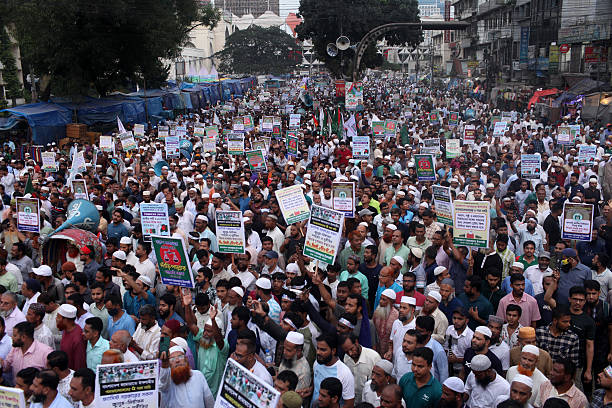
Jamaat’s support for Pakistan during the 1971 war remains a source of anger for many Bangladeshis. But after Sheikh Hasina fled to India during the uprising and senior Jamaat leaders were released from prison, the party has grown markedly more assertive.
“Our leaders and activists suffered throughout the Hasina years. Many of our leaders were executed. Jamaat and Shibir activists were killed, and our political rights were taken away,” Razzak told Al Jazeera, referring to Islami Chhatra Shibir, Jamaat’s student wing. “Now, things have changed. People sympathise with what we went through, and they see us as honest. That is why they will vote for us,” he said.
Founded in 1941 by Islamist thinker Syed Abul Ala Maududi during British rule on the Indian subcontinent, Jamaat evolved from a trans-regional Islamist movement into a distinct political force in Bangladesh.
The party opposed Bangladesh’s independence from Pakistan, arguing it would weaken Muslim political unity and shift South Asia’s balance of power. During the 1971 war, senior Jamaat figures aligned with the Pakistani state and formed paramilitary groups that killed thousands of civilians who were demanding independence.
After independence, Sheikh Mujibur Rahman’s government — Hasina’s father — banned Jamaat in 1972. The ban was lifted in 1979 by BNP founder Ziaur Rahman during his presidency. Over the following two decades, Jamaat re-emerged as a significant political player, backing the BNP-led coalition in 1991 when Khaleda Zia became prime minister for the first time.
During Khaleda Zia’s government, the citizenship of senior Jamaat leader Ghulam Azam — revoked after independence — was reinstated, giving the party a major boost. In 2001, Jamaat formally joined the BNP-led coalition and held two cabinet posts.
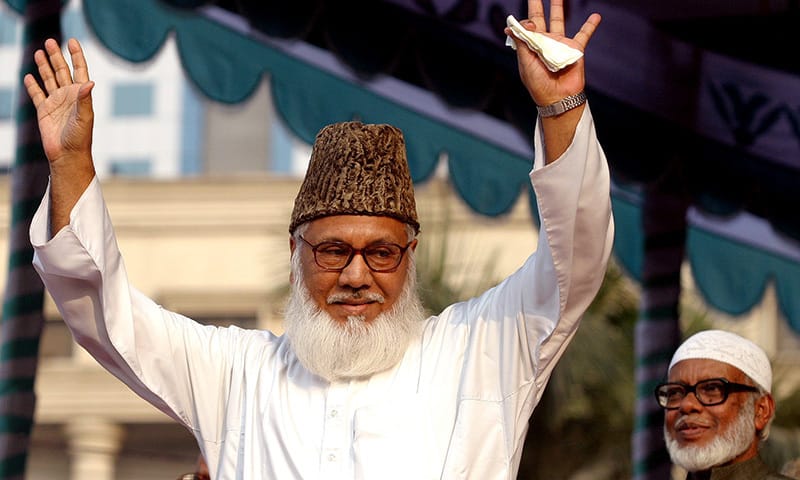
The party’s fortunes reversed again when Hasina returned to power in 2009 and initiated war crimes trials against Jamaat leaders at the International Crimes Tribunal established by her government. Despite concerns raised by rights groups over due process, several senior figures — including former party chief Motiur Rahman Nizami and former Secretary-General Ali Ahsan Mohammad Mojaheed — were executed.
The crackdown devastated Jamaat’s leadership and left the party politically marginalised for 15 years.
Since the 2024 uprising and the lifting of the ban, Jamaat — now led by chief Shafiqur Rahman, deputy chief Syed Abdullah Mohammed Taher and Secretary-General Mia Golam Porwar — has reorganised and emerged as a serious contender in next month’s election.
Party leaders say the revival reflects both public sympathy after years of repression and a deeper frustration with Bangladesh’s established political order.
“For the past 55 years, Bangladesh has largely been governed by two parties: the Awami League and the BNP,” Jamaat deputy chief Taher told Al Jazeera. “People have long experience with both, and many feel frustrated. They want a new political force to govern.”
With the Awami League banned, Jamaat quickly positioned itself as the BNP’s main challenger. Its momentum has been strengthened by recent student union elections, where Islami Chhatra Shibir secured wins at several key campuses.
Taher told Al Jazeera that Jamaat has around 20 million supporters nationwide, with about 250,000 registered members — known as “rukon” — including women. These figures underline the party’s organisational strength, which the newly formed NCP hopes to tap into ahead of the election.
Taher said Jamaat’s broad appeal helps explain its resilience after decades on the margins. Public interest in the party is “growing”, he added. “If this trend continues, we believe we can win a majority.”
Concerns over rise of Islamic party
Jamaat’s resurgence has reignited debate over whether Bangladesh is ready to be governed by an Islamic party, amid fears it could attempt to impose Sharia law or restrict women’s rights.
Jamaat leaders dismiss those concerns, insisting they would govern within the framework of the country’s secular constitution and focus on reform.
“When we come to power, we will accept and implement agreed reforms. Where new laws are needed — for example, to ensure good governance and eliminate corruption — we will examine them at that time,” Taher said.
He also rejected the “conservative” label, describing Jamaat as a “moderate Islamic force” that seeks constitutional reform rather than ideological enforcement.
Taher said the party’s alliances with the NCP — founded by leaders of the 2024 uprising — and the Liberal Democratic Party, led by 1971 war hero Oli Ahmad, aim to “unite the spirit of 1971” with that of 2024, reflecting generational change rather than ideological rigidity.
In a further shift, Jamaat is seeking to broaden its appeal beyond Muslim voters. For the first time, the party has fielded a Hindu candidate, Krishna Nandi, in Khulna, highlighting minority rights in an effort to attract non-Muslim voters, who make up around 10 percent of Bangladesh’s population.
Asif Bin Ali, a geopolitical analyst and doctoral fellow at Georgia State University, said that while many Bangladeshis may be more religious than before, they remain “politically pragmatic, despite personal piety”, and generally prefer politicians to clerics.
“A sizeable part of Bangladeshi society is moving in a more Islamic direction, but that does not mean it is ready to hand the state to a conservative Islamic leadership,” Ali told Al Jazeera. “The centrist and centre-left space is still large and would resist any attempt to reshape the state along strict Islamic lines.”
Thomas Kean, senior consultant on Bangladesh and Myanmar at the International Crisis Group, said Jamaat’s strongest appeal lies less in its religious identity and more in its reputation as a disciplined and comparatively clean political force, particularly among voters disillusioned with both the BNP and the Awami League.
At the same time, Kean cautioned that Jamaat’s history and some of its ideological positions continue to alienate many voters.
“Clearly, Jamaat is on track to record its best-ever results in the upcoming election,” he said. “However, I am sceptical about its chances of winning. This is a party that has never secured even 20 seats, or more than about 12 percent of the popular vote.”
Litmus test for foreign ties
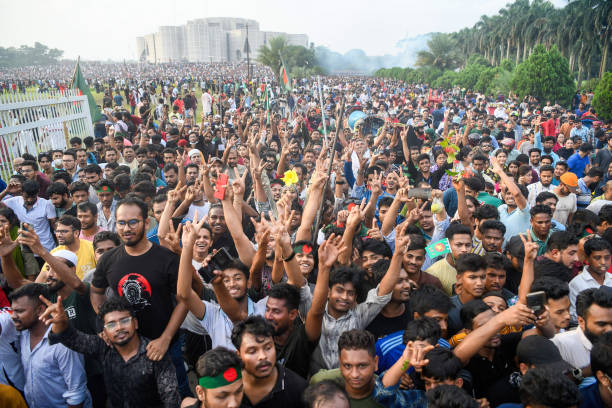
For these reasons, the election — and Jamaat’s performance — may also serve as a test of Bangladesh’s relations with neighbouring countries, particularly India and Pakistan.
Kean warned that a Jamaat-led government would face greater difficulty in resetting ties with India than a BNP-led administration after Hasina’s fall.
“India is looking for a reset after the election, but that will be more challenging with Jamaat in power than with the BNP,” he said, noting that domestic politics in both countries would complicate cooperation between Jamaat and India’s BJP government.
Kean added that long-standing issues — including migration, border security and water-sharing — would continue to strain relations with India regardless of who governs in Dhaka.
Since Hasina’s removal in August 2024, Bangladesh has also moved to rebuild relations with Pakistan, resuming diplomatic engagement, discussing expanded trade and transport links, and holding high-level visits after years of limited contact.
For Jamaat supporters, the February 12 vote represents more than an election. They see it as a referendum on whether a party long shaped by exclusion and controversy can translate organisational resilience into national legitimacy.
Khan, a professor at SOAS University, said the outcome would hinge less on ideology than on governance. “This election will not be about Islam versus secularism, or left versus right,” he said. “It will be about reform versus the status quo. The coalition that offers the most convincing reform agenda while maintaining stability will have the edge.”
NOTE: The views and opinions expressed in this article are those of the author and were originally published by Al Jazeera. They do not necessarily reflect the editorial policy or views of this website. The article is republished with thanks and due credit to Al Jazeera.